
INTRODUCTION
Unplanned downtime is one of industrial manufacturing’s most expensive and most preventable problems. A single unplanned stoppage on a high-throughput production line can cost lakhs of rupees per hour in lost output, emergency labour, expedited logistics, and downstream supply chain disruption. Across India’s manufacturing sector, the aggregate cost runs to thousands of crores annually.The insidious thing about unplanned downtime is that it almost never happens without warning. Equipment rarely fails suddenly. It degrades. It heats up. It vibrates differently. It draws more current. The signals are present in the data — they just aren’t being heard. Digital twins, powered by real-time IoT data and machine learning, build the infrastructure to listen.
What Is a Digital Twin — Precisely
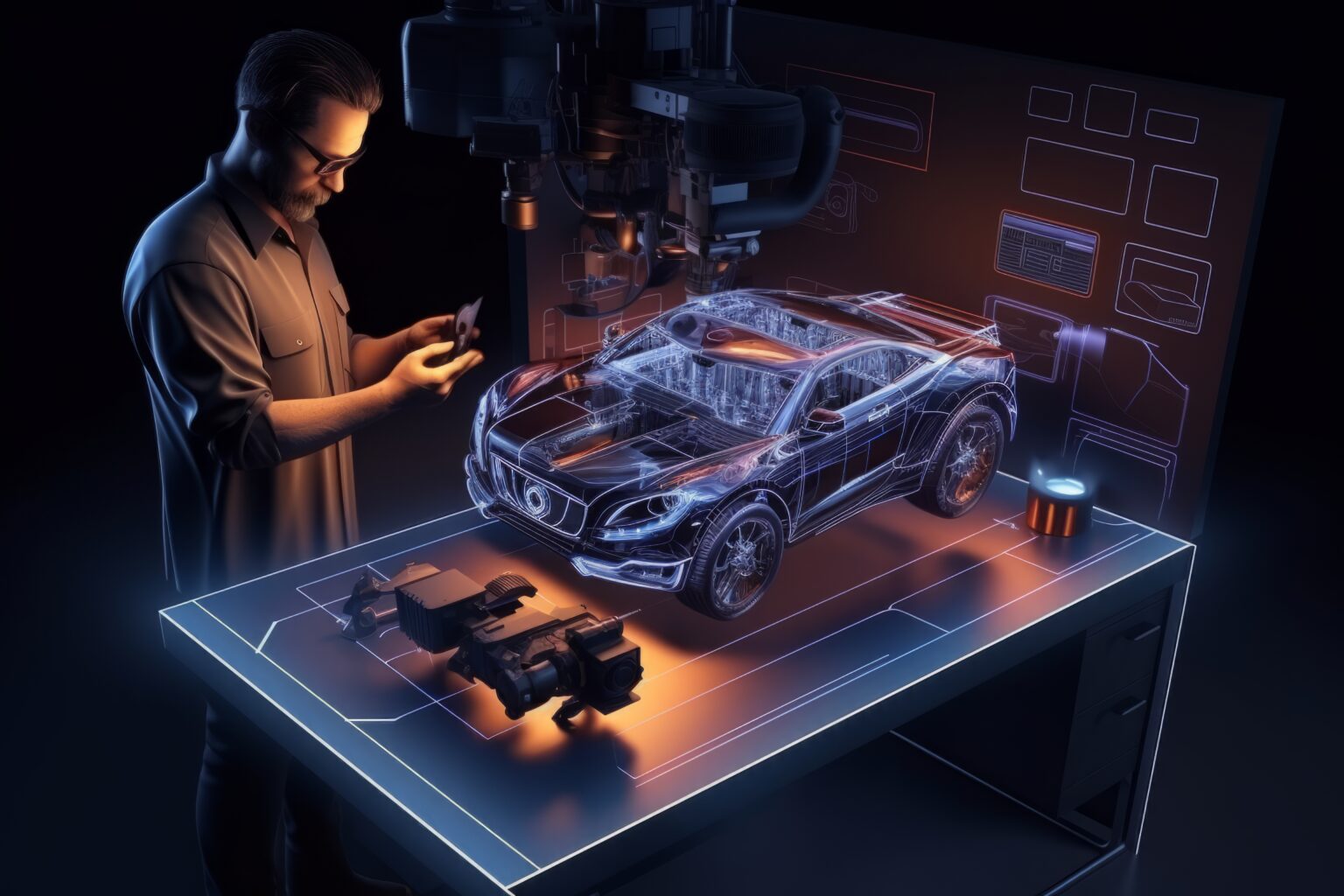
A digital twin is a real-time, continuously updated virtual representation of a physical asset, system, or process. Not a static 3D model. Not a CAD drawing. A living digital counterpart that synchronises with its physical counterpart through sensor data, and that can be used for monitoring, analysis, simulation, and prediction.For a CNC machine, the digital twin tracks spindle speed, tool wear index, vibration signature, thermal profile, and power consumption — updated every second. For a production line, it models throughput, bottlenecks, quality rates, and energy consumption as a dynamic system. For a building, it maps every HVAC unit, electrical panel, and occupancy zone in real time.The transformative capability of digital twins is not just visibility — it is the ability to simulate. Before implementing a production schedule change, run it through the twin and see the downstream effects on throughput and energy. Before approving a maintenance window, let the twin simulate the repair and confirm expected performance restoration.
The Predictive Maintenance Journey: Six Stages
- Stage 1 — Instrument: Deploy vibration, temperature, current, acoustic, and pressure sensors on critical assets. Connect through Xaptronics edge gateways using Modbus, OPC-UA, or MQTT protocols. Establish connectivity without disrupting existing operations.
- Stage 2 — Baseline: Collect 4–8 weeks of operational data across normal operating conditions, varying load profiles, and scheduled maintenance cycles. Establish what healthy looks like for each specific asset — not generic, but machine-specific.
- Stage 3 — Model: Train machine learning models on the baseline dataset. Algorithms learn the unique failure signatures of each asset class — the specific vibration pattern that precedes a bearing failure, the current draw anomaly that signals insulation degradation.
- Stage 4 — Deploy: Run trained models in real time against live sensor data. Generate continuous health scores, remaining useful life estimates, and failure probability scores for each monitored asset.
- Stage 5 — Act: Integrate predictions with CMMS and ERP systems. Auto-generate work orders when health scores fall below thresholds. Reserve required parts from inventory. Schedule maintenance at the optimal window — minimum production impact, maximum intervention effectiveness.
- Stage 6 — Improve: Every maintenance event — what was found, what was done, what the outcome was — feeds back into the models. The system gets more accurate over time. Failure prediction windows extend. False positives reduce.
Real Outcomes from Predictive IoT Deployments
The business case for predictive maintenance is both compelling and fast to realise. Clients implementing Xaptronics’ solution typically achieve a 40–60% reduction in unplanned downtime within the first six months. Total maintenance costs fall by 20–30% as the team shifts from fixed-schedule servicing to condition-based intervention — servicing machines when they need it, not when the calendar says so. Asset lifespan extends by 15–25% because maintenance happens at the optimal point in the degradation curve, not after damage compounds. Spare parts inventory requirements reduce by 10–20% because demand can be forecast rather than buffered against uncertainty. ROI typically crystallises within 4–8 months of deployment — making this one of the fastest-returning capital investments available to plant operations.For a mid-sized manufacturing plant with 200 connected assets, these improvements translate to savings of multiple crores per year from a single IoT implementation.
Beyond Maintenance: The Full Value of Digital Twins
Once the digital twin infrastructure is in place, the value generation doesn’t stop at maintenance. Process optimisation uses the twin to simulate thousands of production parameter combinations and identify the configuration that maximises output while minimising energy. Quality prediction builds ML models that correlate machine condition with product quality, enabling defect forecasting before products leave the line. Energy optimisation identifies which equipment configurations and scheduling approaches consume least energy at each production volume target. Operator training moves to virtual environments — trainees interact with the digital twin before touching real equipment, dramatically reducing both training time and the risk of operator-induced equipment damage. Regulatory compliance is simplified because the twin maintains a complete, immutable digital record of asset condition and maintenance history.
The Architecture That Makes It Work
Xaptronics’ digital twin implementation is built on ThingsBoard’s digital twin module, enriched with a custom ML pipeline. Sensor data flows via MQTT into ThingsBoard. Time-series data is stored in InfluxDB with nanosecond precision, enabling the granular historical analysis that model training requires. ML models run in a containerised Python environment on Xaptronics’ AI engine, with inference triggered on every new sensor reading. Predictions and health scores are written back into the digital twin state in real time. ThingsBoard rule engines evaluate twin state continuously, triggering automated maintenance workflows when thresholds are crossed. The entire stack runs on Kubernetes, scaling from a 10-asset pilot to a 10,000-asset enterprise deployment without changes to the core architecture.
CONCLUSION
The shift from reactive to predictive maintenance is not an incremental improvement. It is a fundamental transformation in how organisations think about physical assets, operational risk, and cost structure. Digital twins give operations teams something they have never had before: reliable foreknowledge of equipment state. The ability to see what is coming, and act before it arrives.Xaptronics has built and deployed this system for clients across manufacturing, energy, and logistics. At IITEX 2026, every component of it is running live at Stall D5-A. Come and see what predictive intelligence looks like in practice.